


- Home
- Information
- Brachycephaly
Brachycephaly in Babies: What It Is and How to Correct It
What is brachycephaly?
Have you noticed that your baby has a flat head at the back? Brachycephaly is a common positional cranial deformity in babies characterized by symmetrical flattening of the back of the skull.
Unlike plagiocephaly, where the flattening is lateral and asymmetrical, in brachycephaly the baby’s head appears shorter and wider, with a flat back.
Although it may seem like a purely aesthetic issue, early action is key to supporting balanced cranial development. The good news is that if detected in the first months, positional brachycephaly can be corrected with safe, non-invasive measures.
How to tell if your baby has brachycephaly?
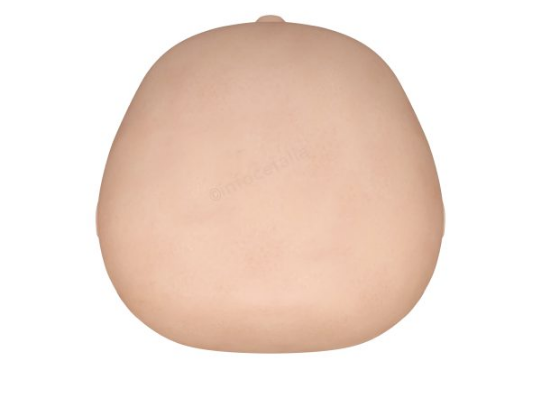
A simple way to identify whether your baby may have brachycephaly is by calculating their cranial index. This value is obtained by comparing the width of the skull (ear to ear) with its length (forehead to the back of the head).
If the width represents more than 81% of the length, it is considered brachycephaly. The higher the percentage, the greater the degree of flattening:
In severe cases, the cranial index ranges between 90% and 100%, giving the head an almost square shape
In moderate cases, values are intermediate (between 81% and 89%), with milder flattening, but early action is still recommended
A physiotherapist or pediatric specialist can help perform this measurement and determine whether intervention is needed.
Brachycephaly or plagiocephaly? Learn to tell the difference
Both are positional cranial deformities, but they have different characteristics:
Brachycephaly
Symmetrical flattening at the back of the head. The baby’s head appears wider and shorter (front to back)
Positional plagiocephaly
Flattening on one side of the back of the skull. It causes facial asymmetry and may involve ear displacement or forehead prominence on one side
Correctly identifying the type of deformity is essential to choosing the most appropriate treatment strategy.
Causes of brachycephaly in babies: why does it occur?
Positional brachycephaly usually develops when a baby sleeps on their back without turning their head, leading to constant pressure on the occipital area (back of the skull).
Common causes include:
- Spending long periods in the same position (crib, bassinet, or bouncer)
- Limited neck mobility (even without obvious torticollis)
- Prematurity (softer skull and lower muscle tone)
- Lack of repositioning and insufficient Tummy Time
The safest sleeping position to prevent Sudden Infant Death Syndrome (SIDS) is on the back, but it is essential to vary your baby’s position during the day to avoid these cranial deformities.

Can brachycephaly correct itself?
Not always. Although some mild cases may improve with growth, waiting is not a good strategy. As the baby grows, the skull becomes less malleable, making correction more difficult:
- After 6 months, the skull’s ability to reshape decreases
- In moderate or severe cases, it is unlikely to fully correct without intervention
- The earlier you act, the better the results. Ideally, intervention should begin when the baby is between 2 and 4 months old, when the skull is more flexible.
Early detection and active postural treatment are therefore essential for effective correction.
How to treat brachycephaly with the Mimos® Pillow
The Mimos® Pillow is a Class I Medical Device specifically developed to prevent and correct cranial deformities such as brachycephaly.
Thanks to its anatomical design with a central cavity, it can:
- Be used from birth during the key months of cranial reshaping
- Eliminate direct pressure on the back of the baby’s head
- Promote a more rounded head shape
- Support better motor development and neck muscle function
- Provide comfort and safety thanks to its breathable, certified materials

What to do if you suspect your baby has brachycephaly
Observe the back of your baby’s head: does it appear flat and wide? If so:
- Consult a pediatrician or specialized physiotherapist
- Do not wait for it to correct itself—act in the first months of life
- Use clinical tools such as the Mimos® Pillow and practice Tummy Time from birth with the help of devices like Mimos® Play
At Mimos®, we offer safe, effective solutions recommended by professionals to protect your baby’s cranial development. Discover them and say goodbye to brachycephaly!
