
- Home
- Information
- Scaphocephaly
Scaphocephaly or Dolichocephaly in Babies: What It Is and How to Treat It
What is scaphocephaly?
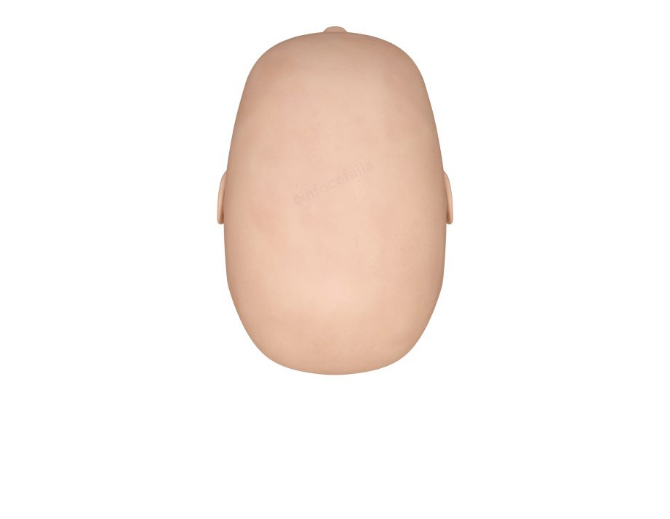
Scaphocephaly, also known as dolichocephaly, is a cranial deformity in which babies have a head that is elongated from front to back and narrow at the sides.
This condition is more common in premature babies, although it can also appear in full-term newborns if they remain in the same side position for long periods of time.
Depending on its cause, we can distinguish between positional scaphocephaly, which is usually easy to prevent and correct, and scaphocephaly caused by craniosynostosis, which is the premature fusion of the skull sutures and must be treated surgically so that it does not affect the baby’s development.
Causes of positional scaphocephaly
Positional scaphocephaly occurs when the baby’s skull is subjected to constant pressure on the sides, especially when:
The baby was premature and spent a long time in the incubator in a side position.
There is limited head movement and the baby maintains repetitive positions without practicing Tummy Time.
The baby always sleeps on their side, or with constant lateral support.
The skull is still very soft and malleable, which is normal in the first months of life.
Differences between positional scaphocephaly and sagittal craniosynostosis
It is important to distinguish between:
Positional scaphocephaly
It occurs when external pressure on the sides of the baby’s skull, for example from always sleeping on one side, prevents it from growing wider.
The cranial sutures remain open, so the skull can be corrected with repositioning and tools such as a cranial orthosis.
Scaphocephaly due to sagittal craniosynostosis
It occurs when the sagittal suture closes prematurely, preventing transverse skull growth. As compensation, the head becomes elongated in the anteroposterior direction.
It requires medical evaluation and, in many cases, early surgical treatment for intracranial remodeling.
Cranial synostosis: consequences of premature closure of the sagittal suture
The sagittal suture is the junction line between the parietal bones of the skull. Under normal conditions, it remains open during the first months or years of life to allow the brain to grow.
Sometimes, however, this suture fuses too early, limiting lateral skull growth and causing the malformation known as craniosynostosis or cranial synostosis.
This causes the head to:
- Become elongated forwards and backwards
- Appear narrow when viewed from above
- Show a symmetrical but disproportionately long shape
If you suspect your baby may have scaphocephaly caused by craniosynostosis, try to see your pediatrician as soon as possible for proper diagnosis and treatment.
The importance of early intervention: how to correct scaphocephaly
In most positional cases, scaphocephaly can be corrected with non-invasive measures, as long as you act early.
What you should know:
- A baby’s skull is more moldable during the first 6 months of life.
- The earlier it is detected and treated, the better the results.
- In older babies, correcting the shape through repositioning alone may be more difficult.
- Waiting for it to improve on its own can reduce treatment options.
That is why it is so important to combine repositioning with clinically proven tools such as the Mimos® Pillow.
How the Mimos® Pillow helps in cases of scaphocephaly
Designed to redistribute pressure on the baby’s skull safely and effectively, the Mimos® Pillow is a Class I Medical Device.
In cases of scaphocephaly, it acts as a preventive and corrective tool thanks to:
- Its anatomical design with a central cavity, which prevents constant pressure on the sides of the skull
- Its ability to promote balanced cranial growth, allowing the skull to widen naturally
- Its hypoallergenic, breathable, and safe materials for use from birth, even in premature babies
- Its proven effectiveness in clinical studies when combined with practices such as Tummy Time or guided repositioning